
Just about everyone knows what a souffle is, but I don’t think anyone’s ever seen one in real life. People think of them as something even master chefs struggle to make. After all, everyone knows the gag of the chef taking his souffle out of the oven, only for it to deflate as soon as it comes out. How awful! The dinner is ruined! His career is gone!
Honestly, though, the popular idea of souffles is pretty far diverged from how they actually work. Souffles aren’t that hard to make, and even though they’re French, they really aren’t that fancy.
The basics
Souffles are a type of egg-based dish. They’re made of whipped egg whites and whatever else you want to fold into it. They can be savory or sweet. This is a baking blog, though, so we’re gonna focus on the sweet version.
The components of a souffle are pretty simple:
- Eggs, separated
- Flavoring
- Roux Base (optional)
You also need a ramekin to make a souffle. A ramekin is a small, cylindrical dish with a short lip at the top. They’re measured in terms of ounces.
Okay, so now you know what’s in a souffle. How do you make it?
Step one: Prepare your base
The base of a souffle can be just about anything. Cheese. Potato. Berries or chocolate. So long as you can safely fold it into a bunch of whipped egg whites, the sky’s your limit.
Along with adding flavor to your souffle, a base needs to be stable. It’s providing the structure for your dish, after all!
In some cases, the ingredients you’re adding are strong enough to make a stable base on their own. Chocolate souffles, for example, often use melted chocolate, which is already sturdy.
In other cases, you might need to add a roux. If you didn’t know, then roux is a kind of thickener. It’s an equal-parts mixture of melted fat and flour that you cook over a stove. It’s used to thicken sauces or sometimes soups.
Step two: Whip your egg whites
One you’ve got your souffle base, the next step is to whip your egg whites. This is the most important part of a souffle, because this is what actually allows them to rise.
When you whip egg whites, the proteins in them break apart and expand, resulting in the formation of lots of air bubbles. When you fold these airy proteins into the rest of the ingredients, the batter retains the air bubbles. When the souffle is heated, the air within these pockets expands, causing the souffle to rise.
Step Three: Wait – did you prepare the dish?
After this, you pour your batter into your already-prepared dish!
To prepare a ramekin, you coat it with butter and then sprinkle in something granular. People often use sugar in sweet recipes and breadcrumbs in savory ones.
This granular aspect of the coating is essential for getting the souffle to rise. When the air heats up and the batter expands, it needs something to cling to if it wants to travel upwards. The sugar provides this necessary friction for it to puff up.
It’s like if you’re trying to climb a wall. It’s much easier to push yourself up if you have a foothold.
Step Four: The Souffle’s Fall
In popular media, it’s usually a joke if a souffle deflates right out of the oven – but that’s what they’re supposed to do! When you take a souffle out of the oven, you’re moving it from a hot environment to a cold one. Once it’s exposed to the cold air, the air inside it contracts, causing the souffle to fall.
Souffles are served right away, before this falling action can begin.
In my experience…
Having said all that, my own first time making chocolate souffles was a disaster.
My first mistake was using ramekins of unknown size. I had gotten them out of a clearance section at an arts and crafts store, and none of them had the ounce measurements on them.
Did you know that the size of a ramekin doesn’t actually match how much it holds? And that the amount also varies by company? I know that now. I wish I had known it before I spent an hour pouring water into cups and looking up obscure Q&A forums.
Everything was pretty downhill from there. I waited until the last minute to prepare the ramekins. I used too many bowls. When I folded melted chocolate into egg whites, the mixture was so uncooperative I almost threw the bowl into the sink and called it a night.
In the end, though, they still turned out okay! Despite all my mistakes, all the souffles still rose (and only one of them ended up cracking):
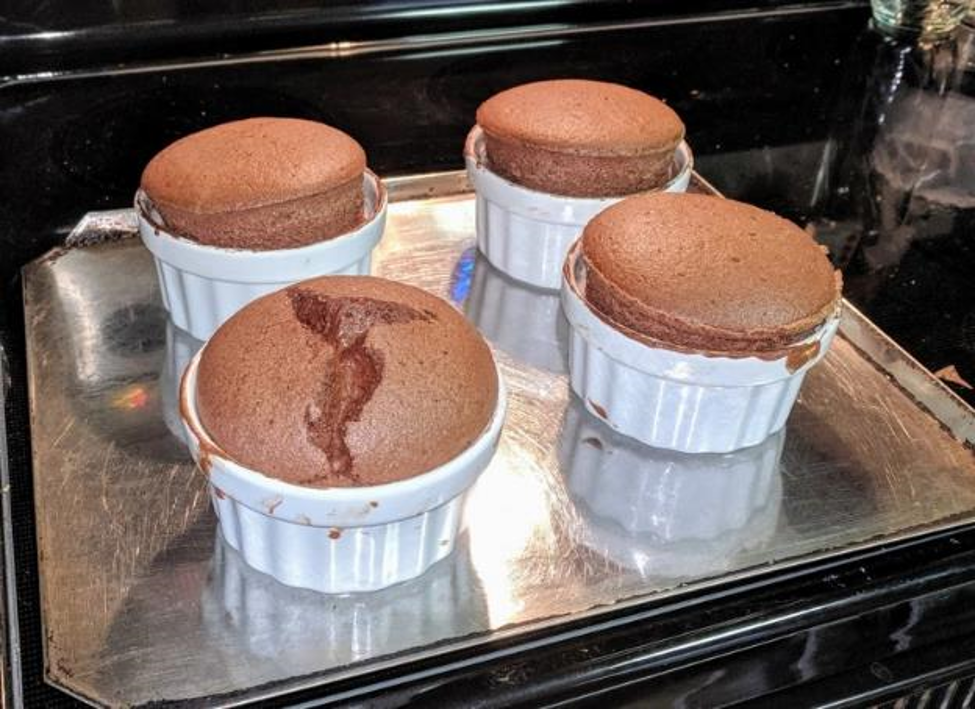
But that just means you don’t need to be a great chef to make a souffle.
And, yes – they all still fell.
 Behind the Baking