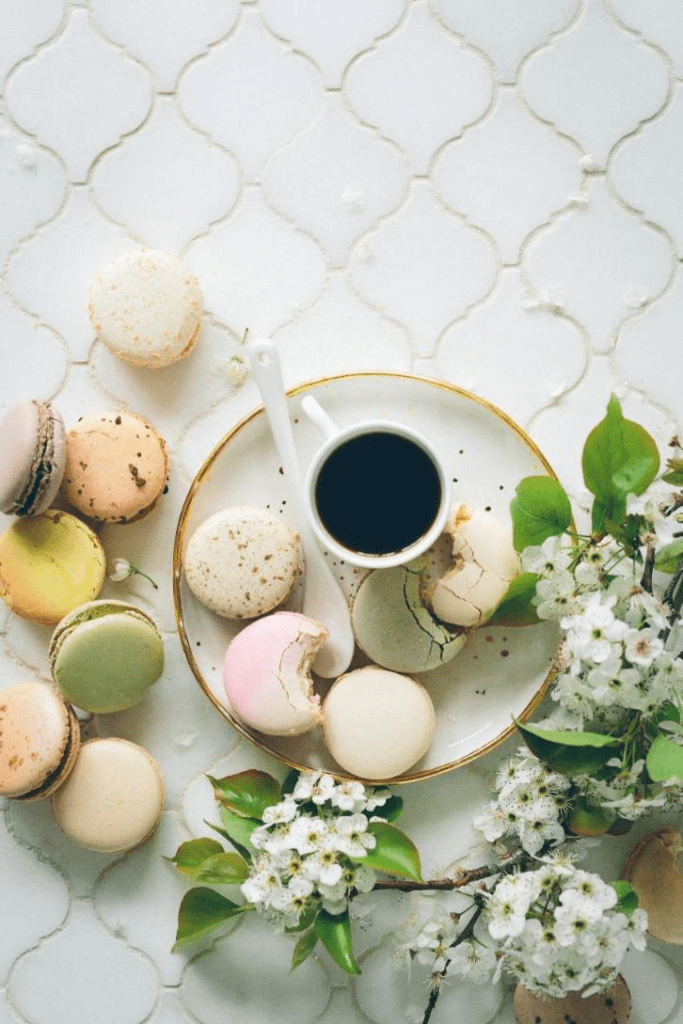
Macarons usually have an air of expense and prestige around them, but once you know how they’re made, they lose a lot of that manufactured fanciness. They also become pretty easy to make yourself!
A macaron has two parts: the cookie shell, and the filling.
Basic macaron shells are made up of four ingredients:
- Almond flour
- Powdered sugar
- Egg whites
- Granulated sugar
That’s it! Super simple.
About the egg whites
Macarons are a meringue-based cookie. Meringue is a combination of whipped egg whites and sugar.
All the leavening in these cookies comes from the egg whites. When they’re whipped, the proteins in eggs expand, resulting in lots of air bubbles being trapped in the meringue. When hot air expands in these air bubbles, they rise.
When you make macarons, you want to beat the egg whites to very stiff peaks. One of the classic tests to tell if they’re done is to take the bowl and hold it over your head. If they stick in the bowl, you’re good!
Getting the right batter consistency
The “tricky” part of making macarons comes when you combine everything together.
Macarons are made with almond flour, so the purpose of this process is not to form gluten. Instead, the folding process is meant to beat air out of the batter!
The infamous advice for macaron-makers is that the batter must be a “lava-like consistency” before you make it. But what even IS lava-like? This advice is worthless for people who have never made them before.
The best way to figure out the proper consistency is to watch someone make macarons. The second-best way is to pull together various descriptions and cry.
Preparing for baking
Once you’ve got the batter and you’ve piped it out, macarons require a few extra steps before they go in the oven.
These steps don’t actually change the flavor, but they are necessary for getting the famous look of the macarons.
First, you need to slam the tray down on a table a few times! This allows any air bubbles trapped in the batter to rise to the surface. That way, they won’t rise when baking and ruin the smooth outer shell of the macaron.
Second, you need to let them sit for a while. Your goal is to dry out the top of the macarons – enough that they don’t stick to your finger when you touch them. This is necessary for forming the foot of the macaron.
Once the film is set and there’s no air bubbles, you bake them!
Filling the macarons
Now that your macarons have baked cooled, you have to put something between them. That’s why they’re sandwich cookies, after all.
The fillings of macarons can be just about anything you want them to be, honestly. The most common ones I’ve seen are buttercream, fruit curds, or some kind of ganache.
Since the cookie part of the macaron is pretty sweet, I’ve always preferred fillings that are bitter or tangy. You can put in whatever you think best compliments the outer flavor.
Serving your macarons
You should serve your macarons the day after you make them. This allows the flavors to meld and for the filling to soften the shell, which makes the texture more uniform.
In conclusion…
Although macarons may look fancy, they really aren’t as out-of-reach as some people may fear. So long as you know what you’re doing, they should come out okay.
(This is my go-to recipe for chocolate macarons, by the way.)
Making macarons really shouldn’t be a stressful process. If you want to strive for those picturesque macarons, then go ahead! But if you’re making them for yourself or for some friends, then it doesn’t matter if they didn’t come out how you wanted them to.
If you give your friend a macaron, then they aren’t going to complain about how it looks. They’re going to say, “Oh my god, is this a macaron?!” And then they’ll eat it and think you’re some kind of baking genius.
It happens every time.
 Behind the Baking